before you start reading
This is the first in a series of excerpts from my thoughts during the seminar “The Role of Government.” I decided to revisit them and turn them into a quasi-newsletter: a few ideas at a time, starting with nudges.
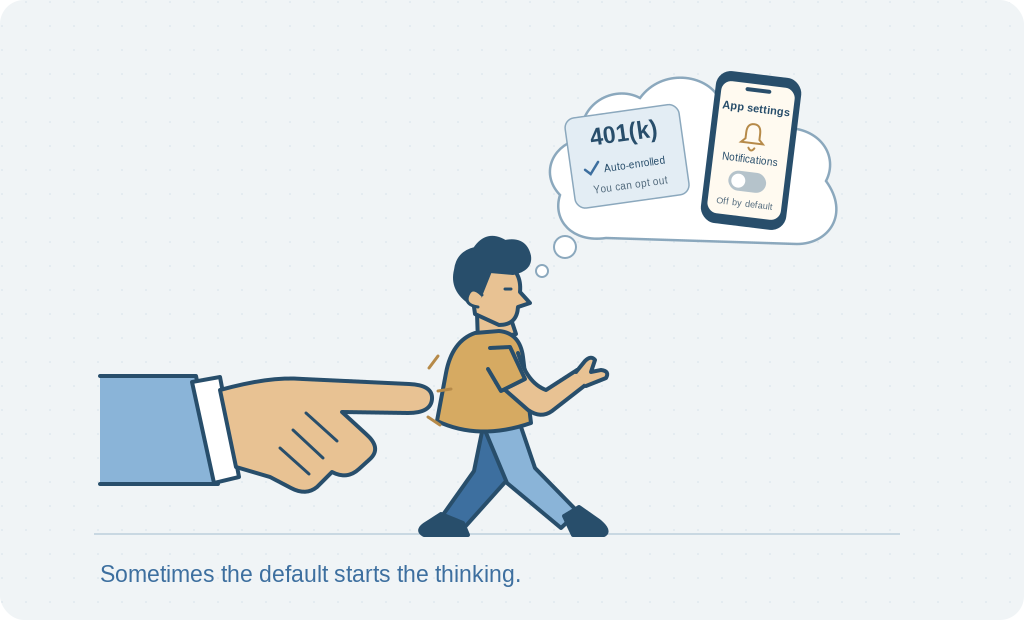
If you start a job in the United States, there is a good chance you will be enrolled in a retirement savings plan before you have thought about it. The government encourages employers to offer the plan. The employer enrolls you by default. You can opt out any time. Almost nobody does.
Richard Thaler and Cass Sunstein call this libertarian paternalism, or, in the shorter word that stuck, a nudge (Thaler & Sunstein, 2021). The choice is yours. The default is theirs. The question I want to take seriously is whether that arrangement is good for a society, how good, and where it starts to look like something other than freedom.
My answer is that it is very good, better than most of the legislative tools we reach for first, and that it has one effect almost nobody credits it with. I think nudging, done honestly, makes people think more for themselves, not less.
The path of least resistance
Opt-in enrollment
Automatic enrollment
Thaler and Sunstein split the mind in two. There is the econ, the rational, self-interested, utility-maximizing agent that economic models are built around. And there is the human, who is biased, impatient, swayed by whatever is in front of them, and makes most of the actual decisions. Everybody has both. Which one shows up depends on the context, on the hour, on how tired you are.
The econ
- Reflective
- Self-interested
- Weighs the long run
- Rarely in charge
The human
- Impulsive
- Overconfident
- Prefers now to later
- Hates losing
Everyone has both. Policy that assumes only the first one will miss.
Most people, asked directly, will concede that the econ makes better decisions, because the econ is the one that stops and reflects. So a policymaker should try to summon the econ whenever possible. But people use the human far more than they believe they do, and a policy that only works when the econ is driving is a policy that will mostly fail. To design for real people is to design for their biases.
Three biases help explain why knowing what would be good for us is often not enough to make us do it: overconfidence, present bias, and loss aversion. Each creates a different problem for someone designing a policy.
Overconfidence means trusting our own judgment more than we have reason to. Someone might put off saving because they are sure they will earn more later, without thinking seriously about what happens if they don't. Simply telling them to save is unlikely to settle that disagreement. The idea is to entrust them with a choice between two plans: one based on the income they expect, and one based on their income staying flat. Neither plan can tell them what will actually happen, and both depend on assumptions that may turn out to be wrong. But comparing the two gives them something concrete to base their decision on.
Present bias is the tendency to give more weight to what we want now than to what we will want later. I can want a comfortable retirement and still prefer having the extra money in this month's paycheck. One possible nudge is to let me commit today to saving part of a future pay raise. I make the decision before the money feels like something I am giving up. That does not remove the cost of saving, but it changes when I have to face the choice.
Loss aversion means that giving something up can feel worse than gaining the same thing feels good. A retirement contribution can therefore look like money disappearing from my paycheck, even though it is still mine. Where an employer offers matching contributions, a reminder could show how much of that match I leave unclaimed by not enrolling. The point is to make the cost of doing nothing visible too.
There is one more point I'd like to make. Nudging creates a competition over how to influence people. Once it is accepted that defaults steer people, there is a race between those who can steer with a light touch and those who can only steer by force. Firms compete on it. Agencies compete on it. The winners are the ones who move behavior while leaving choice visibly intact, which is a far better thing to be competing on than who can write the most restrictive rule.
But there is an objection to that competition: firms and agencies could get better at steering us without making us think for ourselves. I think a nudge can also do the opposite. Someone who is nudged toward an uncomfortable decision is someone who has just been made aware that a decision exists. People who would never have looked into the retirement plan now have a reason to. Think about it: would we even be discussing these defaults if they hadn't prompted us to question how choices are made? That does not mean everyone will stop and reflect, but it is one way a nudge can spur independent thought.
The default does not end the thinking. It often starts it.
The problem is that independent thought does not reliably produce better-informed decisions, which is the weak point of the argument. It can produce worse ones. However, the fix for that is not fewer nudges but a more basic one: education as a universal default, so that when the thinking starts, it has something to work with. A population that has been taught about its own biases is one that can be nudged less, and more gently, over time.
So libertarian paternalism is not always the best choice. But it is almost always better than any policy that makes people feel their freedom has been taken, and that feeling has costs of its own that rarely appear in the analysis. The common good comes from balancing the two tools well. That balance requires policymakers who are actually trying to improve the public's condition rather than win an argument, which is a harder default to install than any retirement plan.
How did this land?